
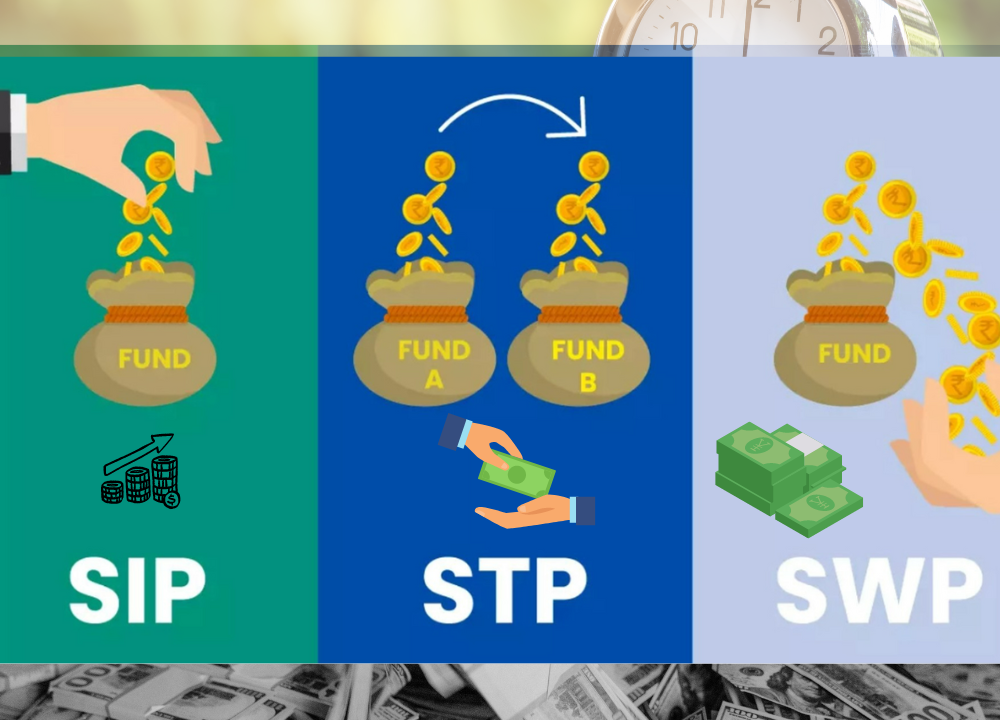
Investments are easier to understand when the concepts are explained in a clear manner. Most investors get puzzled when they read expressions such as SIP vs STP vs SWP since they appear to look similar although they have entirely different applications. They all belong to a particular phase of your finances and are used to efficiently organize the management of money.
A combination of SIP, STP and SWP is a complete investment cycle. This is how it works, you set aside a sum of money consistently, then think wisely with big amounts of money and eventually get the cash when you have to. Such a disciplined method minimizes risks and enhances financial discipline.
You will see the concepts step-by-step, in this guide. You will also learn their application and co-operation in achieving improved outcomes.
What is SIP (Systematic Investment Plan)?
A Systematic Investment plan is whereby you put a fixed sum in a mutual fund at a fixed time. It is usually done once a month, and can be used by those who earn regularly. SIP enables you to invest without the concern about time in the market.
This is a way that operates on the concept of consistency. You do not wait until it is the right time, but invest and have time on your side. In the long term, this strategy can assist in creating wealth via compounding.
SIP is flexible too. Depending on your financial condition, you can increase, cut, stall or quit investment. This renders it to suit both the novice and the experienced investors.
Key Features of SIP
SIP is one of the most popular types of investments due to a number of features that it possesses. It helps in being disciplined and lowering emotional decision-making.
- It encourages frequent practices of investing.
- It balances market variations using rupee cost averaging.
- It has a compounding advantage.
- It provides flexibility in terms of amounts and duration of investments.
- It eliminates timing in the market.
How SIP works over time with periodic investment needs to be considered before going further.
| Investment Parameter | Value |
| Monthly Investment | ₹10,000 |
| Investment Duration | 25 Years |
| Total Invested | ₹30 Lakhs |
| Expected Return | 12% |
| Final Value | ₹1.9 Crore |
This table indicates how a little monthly investment can build to a big corpus having been kept over a long time.
When Should You Use SIP?
When you have a good income and long-term objectives, SIP works best. Not just money but an obligation to save on a regular basis.
You can use SIP in the following cases:
- When you have a set monthly earning and would like to invest a certain amount on a regular basis.
- When your ambitions are further such as retirement, house purchase, or education.
- When you feel like not being in that stress caused by market boom and slip.
- When you want a straightforward and automated method of investing.
SIP prevents you to get out when there is a market. It gets the pressure of when to invest out of the way and you are able to concentrate on the long term growth.
What is STP (Systematic Transfer Plan)?
A Systematic Transfer Plan enables you to move money in one mutual fund into a other one at regular periods. It is applied primarily where you are starting with a lump sum of money and you wish to invest in bits.
STP does not require making investment in one lump sum; instead, the investment is made over time. This minimizes chances of entering the market when it is too expensive. It also makes sure your money is invested and not lying idle.
STP typically entails shifting an amount of money in a debt fund to an equity fund. This balances the safety, growth and risk management.
Key Features of STP
STP offers a methodological way of managing big investments. It assists in keeping discipline and minimizing emotional decisions.
- It enables the step-by-step investment of lump sum money.
- It minimizes the reflectiveness of timing in the market.
- It makes the idle funds to be better utilised.
- It helps in easy switching between asset classes.
- It offers ease of transfer value and length.
Before proceeding further, it is important to know how STP works in a real-life situation.
| Step | Process |
| Step 1 | Invest lump sum in a debt fund |
| Step 2 | Decide fixed transfer amount |
| Step 3 | Set regular transfer schedule |
| Step 4 | Gradually move funds to equity |
This approach will see your investment diversified at varying levels in the market and hence minimizes risk.
When Should You Use STP?
STP can be employed when you ever get a considerable sum of money and you are planning to invest the money. It assists in curbing anxiety and enhances decision making.
You are supposed to use STP in the following scenarios:
- You receive a bonus, out of an inheritance, or selling the proceeds.
- When you do not have the time to invest the full amount at a time.
- In case you wish to move to a less vulnerable market investment.
- When you intend to rebalance your portfolio overtime.
STP makes sure that your investment process is smooth and controlled. It can save you losses associated with the wrong time.
What is SWP (Systematic Withdrawal Plan)?
A Systematic Withdrawal Plan is where you can withdraw a specified amount of money in your mutual fund at a set period. It is the converse of SIP and instead of getting money periodically, you get it by investing.
SWP is the most appropriate when you do not want to create wealth, but to earn income. It enables you to have the advantage of your investments without necessarily taking the full amount at a given time.
This technique is usually applied in the context of retirement. It offers a continuous income with the rest of the money invested being running.
Key Features of SWP
SWP offers a flexibility and stability in withdrawal management. It promises to deliver your money longer and satisfy your monetary requirements.
- It gives a consistent revenue at a certain frequency.
- It maintains the other investment rising.
- It is flexible in withdrawal amounts.
- It aids in keeping costs under control.
- It assists in financial planning in the long run.
It is handy to consider a practical example before comprehending its significance.
| Parameter | Value |
| Total Investment | ₹1 Crore |
| Monthly Withdrawal | ₹50,000 |
| Remaining Corpus | Continues to grow |
| Purpose | Income generation |
This demonstrates how SWP is useful in equalizing income requirements and growth in the long term.
When Should You Use SWP?
SWP would suit where you require an ordinary income off your investments. It is frequently employed in retirement or when you would like to generate a continuous cash flow.
In these cases you should take SWP into consideration:
- Where you require a fixed monthly payment.
- In times of wanting to control retirement cost.
- You want to have certain withdrawals rather than one lump sum.
- When you wish to keep on growing your remaining investment.
SWP will see to it that your savings will be utilized efficiently without going out of hand.
SIP vs STP vs SWP: Detailed Comparison
When compared, you will find it easier to understand SIP vs STP vs SWP. Every approach is different and corresponds to a various step of investing. Remind before you peep at the table that these methods are more or less particular. They are complementary to one another.
| Feature | SIP | STP | SWP |
| Meaning | Regular investment | Transfer between funds | Regular withdrawal |
| Cash Flow Direction | Bank to fund | Fund to fund | Fund to bank |
| Purpose | Wealth creation | Gradual investment | Income generation |
| Suitable For | Salaried individuals | Lump sum investors | Retired individuals |
| Risk Handling | Reduces volatility | Reduces timing risk | Depends on withdrawal |
| Flexibility | High | Moderate | High |
| Stage of Use | Beginning | Middle | End |
This table gives a good insight into the difference between SIP vs STP vs SWP.
How SIP vs STP vs SWP Work Together?
SIP vs STP vs SWP are not distinct strategies. They are interrelated and assist every step of your personal financial plan. SIP is your starting point to accumulate wealth. You pay out in STP when you get big amounts of money. When you generate more wealth than you desire, then you employ SWP to earn income. This method establishes an efficient and organized investment procedure. It eliminates risk, enhances discipline and leads to improved financial results.
Common Mistakes to Avoid in SIP vs STP vs SWP
Some common mistakes that are committed by many investors in the application of these strategies include: These errors have the ability to diminish returns and risk.
You should not, the following:
- Investing a sum of money without STP.
- Cessation of SIP when markets were at a low point.
- too much too soon by means of SWP.
- Failure to match your strategy with your financial objectives.
Appreciating the SIP vs STP vs SWP in the most appropriate manner will assist you to circumvent these errors and make superior investment choices.
Conclusion: Importance of SIP vs STP vs SWP
A combination of SIP vs STP vs SWP makes a complete investment plan. All approaches are applicable to another aim and facilitate a particular financial objective.
Consistency and discipline assist you to accumulate wealth with the help of SIP. STP assists you in dealing with big investments in an organized manner. SWP assists you in earning money and in maintaining your funds.
Combining SIP with STP vs SWP develop a balanced financial plan. This will guarantee growth, stability, and financial stability in the long run.
Also Read About :- Top Mutual Funds in 2026: Best Funds & Investment





Leave a Reply