
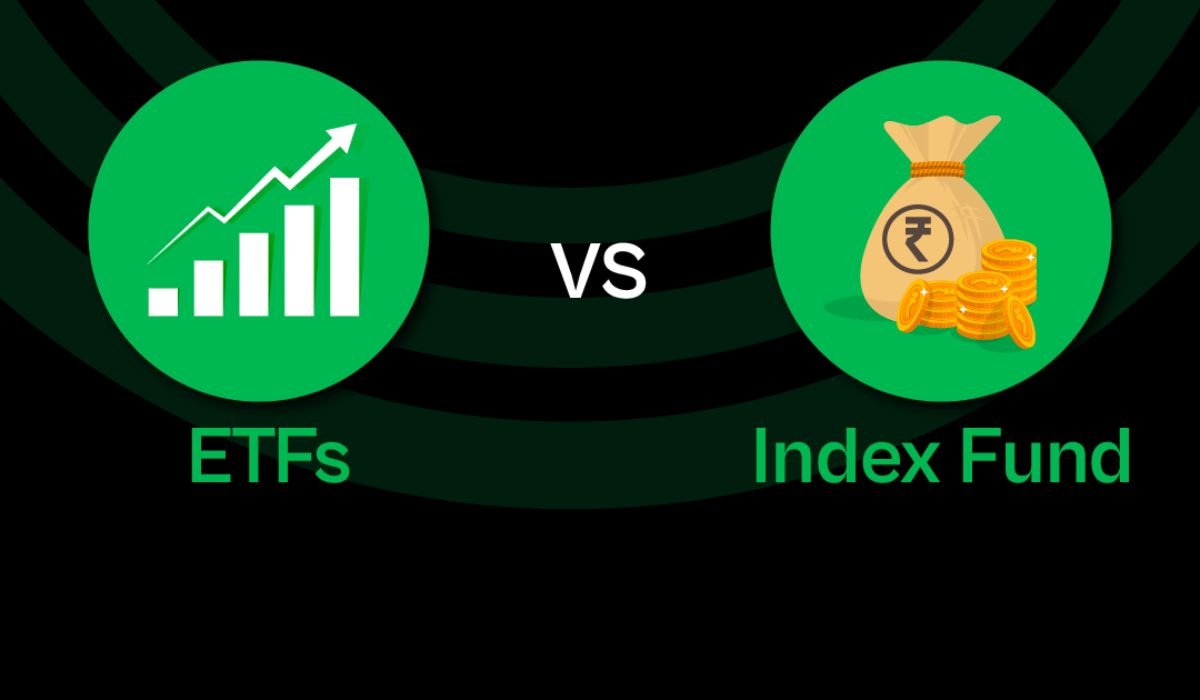
Accessibility and ease of investing on the stock market has never been easier. But many investors still have a problem deciding on the right investment vehicle for them to build along for their life-saving accumulation. Versus Index Funds is considered one of the most popular forms of passively investing these days. These two choices allow investors to closely follow the performance of a market index, instead of active fund managers.
The two investment options are designed to mimic stock indices like the Nifty 50 and BSE Sensex. As a result, they’re more diversified, less expensive, and more unbiased to the management team. Whereas ETFs are fairly similar, there are a few key differences between ETFs and index funds.
What Are Exchange Traded Funds (ETFs)?
Exchange Traded Funds (ETFs) are investment vehicles listed on stocks markets like shares. Investors are allowed to trade ETF units through the trading account during the market hours. ETFs are therefore more liquid and flexible for trading due to the real time pricing and trading.
The majority of the ETFs follow the various indices like the Nifty 50, BSE Sensex or sector specific indices. Readjusts the portfolio to replicate the composition of the index.Takes corrective action on the fund to make sure the portfolio is closely aligned with the index. As such, the ETFs normally track the index.
What Are Index Funds?
Economics Terms Index Funds are mutual funds that aim to track a particular stock index. These funds don’t try to outperform the market; they just follow the market. Thus, index funds have a passive investment approach.
For instance, if one subscribes to the Nifty 50 track, they’ll invest in the exact same 50 companies that make up the index. It also maintains the same weightage for each company. This structure means that closely index funds are tied to the performance of the index.
Key Differences Between ETFs Versus Index Funds
The structural differences are important to recognize to determine which investment option is best. While both investment approaches are passive, they are easily accessible and trade differently.
Comparison: ETFs Versus Index Funds
| Feature | Index Funds | ETFs |
| Investment Style | Passive | Passive |
| Trading Method | Purchased through mutual fund platforms | Traded on stock exchanges |
| Pricing | Calculated once daily at NAV | Market price changes throughout the day |
| Demat Account | Not required | Required |
| Expense Ratio | Low | Usually slightly lower |
| Liquidity | Moderate | High |
| Trading Flexibility | No intraday trading | Intraday trading available |
| Accessibility | Easy for beginners | Requires trading knowledge |
It is evident that there are some core differences between ETFs vs index funds, particularly in terms of trading flexibility and ease.
Advantages of ETFs
Many investors favor the flexibility of ETFs and their instant exposure to the market. They provide a number of benefits, being traded like stocks.
1. Real-Time Trading
ETFs can be purchased or sold at anytime during normal trading hours. This allows them to move accordingly in response to market movements.
2. Lower Expense Ratios
Companion products such as ETFs have slightly lower expense ratios often than index funds. The result, long-term investors can cut down on investment expenses.
3. High Transparency
The majority of ETFs release an itemization list of holdings every day. So, investors are aware of the investment of their funds.
4. Better Tracking Efficiency
ETFs tend to be highly correlated to the index. Therefore, they usually have lower tracking errors compared to some index funds.
These are the advantages that entice investors to choose ETFs over index funds.
Limitations of ETFs
While ETFs have some benefits, there are also drawbacks investors should keep in mind prior to investing.
1. Demat Account Requirement
To invest in ETFs, one should be equipped with both trading and Demat account. This could put off would-be newcomers.
2. Brokerage Charges
There is brokerage fee associated with each trading and sometimes there are the bid-ask spread as well with every ETF transaction. These costs can slowly decrease returns over time.
3. Liquidity Issues in Some ETFs
While popular ETFs may have higher trading volumes and be much more liquid, there will be smaller ETFs that will not have as high of trading volume. So, the investor could experience larger spreads during their trading activities.
These are some of the main considerations when reviewing ETFs Versus Index Funds, particularly for beginners.
Advantages of Index Funds
Despite being one of the most basic investing strategies, index funds continue to be a popular choice for investing in the stock market. They are favored by many long-term investors due to their accessibility and simplicity.
- 1. Easy Investments Process: Investors can directly buy index mutual funds from index mutual fund websites. Hence, they need not have a demat account.
- 2. Best For SIP Investments: SIPs are allowed by index funds. This means that investors have the option of investing in small amounts regularly.
- 3. Passive Investment Friendly: As an index fund needs less attention, it is suitable for the Passive Investors who want to take a long-term perspective.
- 4. Fewer Trade Mistakes: Investors make trades only once a day, eliminating the need to make emotional choices as they deal with intraday decisions.
Limitations of Index Funds
While index funds are simple, there are some drawbacks to using them.
- No Intraday Trading: Investors are not allowed to trade units of the index fund within the course of the day of the market. Instead, the transactions are done based on the daily NAV.
- Low but Slightly Higher Expense Ratios: Index funds can have expense ratios low, but slightly higher than ETFs.
- Tracking Error Possibility: Small cash balances in some index funds. So we could see some differences among the returns of their portfolios and the index to which they are compared. These can be salient issues in ETFs VS Index Funds debate.
When comparing programs, consider costs and their expense ratios, as well as taxes.
Cost Comparison: Expense Ratios and Taxes
Passive investment is a strategy that is common to both types of investment.Passive investment is a strategy shared by both types of investments and is generally characterized by relatively low management costs. But, the expense ratios of these ETFs tend to be slightly cheaper. On the contrary, the management fee for index funds can be somewhat higher.
Liquidity and Trading Access
Another significant distinction between the two investment choices is the liquidity.
ETFs are traded through the stock exchanges. As a result, they are easily bought and sold by investors right away during their trading hours. This feature will enable investors to respond swiftly to market fluctuations.
Index funds are different. Investors make trades directly with asset management companies and trades are made at the end-of-day NAV price. This means that investors are unable to profit from the intraday fluctuations in the price of the securities.
Which Investors Should Choose ETFs?
Some investors might prefer to invest in ETFs.
- The policies apply strictly to investors whose account is a demat account.
- Traders who love to trade in real-time.
- Investors seeking slightly lower expense ratios
- People who are at ease for the trading system of the stock exchange market.
These investors can get more control and flexibility by investing in ETFs. ETFs are, therefore, an appropriate investment for with more experience in the market.
Which Investors Should Choose Index Funds?
This might be suitable for investors who want a simple and automated investing approach.
- Beginning investors in the stock market
- Individuals who are interested in SIP-based investing
- Those who do not wish to embrace trading complexity.
- Investors with a passive approach who invest in stocks for the long-term
These investors tend to focus more on convenience than in terms of trading flexibility. Thus, index funds are still popular.
Conclusion
But both ETFs and index funds are great choices for getting in cost-effective ways to invest in the stock market. These provide diversified, transparent and index-wise passive exposure to top indices like Nifty 50 and BSE Sensex.
But all of this rests on the investor preference and investment style and it’s simply a choice between ETFs vs. Index Funds. Investors who are comfortable with a trading platform may prefer ETFs due to their attractiveness in terms of cost and ability to trade in real-time. At the same time, the benefit to an index fund is its simplicity, flexibility of SIPs, and availability for a novice investor.
Also Read About :- SIP Vs Lumpsum: Which Investment Strategy Is Better in 2026?


Leave a Reply