
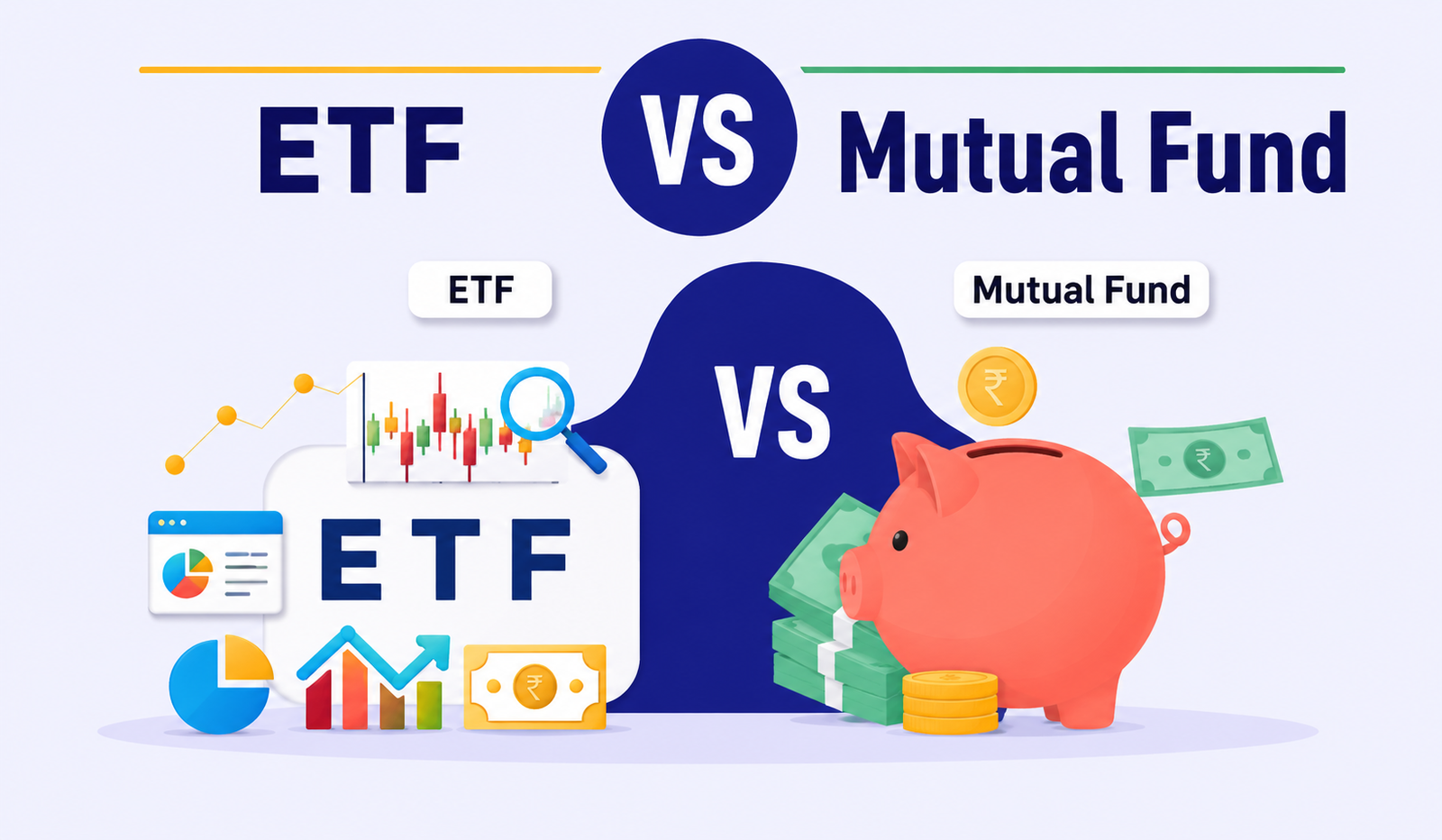
There has never been as much options to choose between as there are nowadays when it comes to personal finance, but when it comes down to it, one question tends to dominate all the ETF vs mutual funds. Both these alternatives enable investors to create diversified portfolios without individual securities selection, but they operate differently and are applicable in different investing styles.
In the event that you want to create long-term wealth, plan your retirement, or receive passive income or just be able to grow the money efficiently, it is crucial to understand the various differences between these investment vehicles. Although the popularity of ETFs has risen due to low cost and flexibility, mutual funds continue to be the preferred choice by millions of investors who believe in professional management and provide automated investing.
The bad news is that both of the pictures are not inherently good. The best decision will depend on your financial objectives, investment horizon, risk-taking capability and experience in investing. This guide will tell you all you need to know about mutual fund vs ETF and additionally discusses the slightly more popular mutual fund vs ETF vs index fund and ETF vs mutual fund.
ETF vs Mutual Fund: Quick Comparison
| Feature | ETF (Exchange-Traded Fund) | Mutual Fund |
| Trading | Traded throughout the day on stock exchanges | Bought and sold once daily at NAV |
| Pricing | Real-time market price | End-of-day NAV |
| Management Style | Mostly passive | Often actively managed |
| Expense Ratio | Lower | Higher |
| Demat Account | Required | Not required |
| SIP Facility | Limited | Widely available |
| Transparency | Daily holdings disclosure | Monthly or quarterly disclosure |
| Tax Efficiency | Generally higher | Moderate |
| Liquidity | High | Moderate |
| Flexibility | High | Moderate |
| Best For | Passive investors and traders | Long-term SIP investors |
What Is the Difference Between ETF and Mutual Fund?
Purchasing and selling of ETFs and mutual funds is the largest distinction between the two. ETFs are traded in an exchange as stock are traded all day and mutual funds are bought directly through fund houses at the end of the day at the merit price. The differences however are not confined to trading and pricing alone.
Detailed ETF vs Mutual Fund Comparison
| Feature | ETF | Mutual Fund |
| Full Form | Exchange-Traded Fund | Mutual Fund |
| Investment Style | Mostly passive | Often active |
| Buying Process | Through stock exchange | Through AMC or platform |
| Trading Timing | Throughout market hours | Once daily |
| Price Determination | Market price | Closing NAV |
| Fund Manager Activity | Low | High |
| Expense Ratio | Lower | Higher |
| Transparency | Daily updates | Periodic disclosure |
| Demat Account | Mandatory | Not required |
| Brokerage Charges | Applicable | Usually none |
| SIP Facility | Limited | Easy and automatic |
| Minimum Investment | Cost of one unit | Starts from ₹500 in many funds |
| Tax Efficiency | Higher | Moderate |
| Trading Flexibility | High | Low |
| Best Investor Type | Cost-conscious investors | Hands-off investors |
Quick Decision Guide
| If You Want… | Better Choice |
| Lowest fees | ETF |
| Automatic investing | Mutual Fund |
| Professional management | Mutual Fund |
| Intraday trading | ETF |
| Maximum transparency | ETF |
| Beginner-friendly investing | Mutual Fund |
| Long-term passive investing | ETF or Index Fund |
Among the key things that a lot of investors fail to recognize is that investment behavior oftentimes is more significant than the actual vehicle of investment. Someone who invests monthly in a good quality mutual fund but with a sense of discipline will out trade someone who regularly purchases and sells ETFs due to emotional reactions in the market.
What Is an ETF (Exchange-Traded Fund)?
An ETF is a collection of securities that is traded in a stock exchange as a normal stock is. The majority of ETFs are index trackers, and not index beaters. As an example, a Nifty 50 ETF tries to track the performance of the Nifty 50 index in an attempt to acquire the same companies in the same proportions.
Investors can purchase a single ETF unit and have exposure to the whole index as opposed to buying 50 individual company shares.
Popular Types of ETFs
| ETF Type | Tracks |
| Nifty 50 ETF | Nifty 50 Index |
| Sensex ETF | Sensex Index |
| Gold ETF | Gold Prices |
| Nasdaq 100 ETF | Nasdaq 100 Index |
| Banking ETF | Banking Sector |
| Bond ETF | Government or Corporate Bonds |
Costs of management of most ETFs are fairly low since these ETFs have a relatively low management strategy as they operate according to a passive investment plan.
Advantages of ETFs
- Lower expense ratios
- Intraday trading flexibility
- High transparency
- Tax-efficient structure
- Easy diversification
Disadvantages of ETFs
- Demand Demat and trading account.
- Brokerage charges apply
- There are few SIP options.
- They might be inconvenient to beginners.
What Is a Mutual Fund?
A mutual fund is investment of thousands of investors in a single pool of money which is then invested as per a given strategy by professional fund managers.
Most ETFs do not work actively in selecting investments as many mutual funds do and aim to outperform a benchmark index.
The fund manager does continuous research on companies, shifts portfolio and tries to deliver better returns.
Types of Mutual Funds
| Fund Category | Objective |
| Large Cap Fund | Invests in large companies |
| Mid Cap Fund | Focuses on medium-sized firms |
| Small Cap Fund | Targets smaller growth companies |
| Debt Fund | Invests in fixed-income securities |
| Hybrid Fund | Mix of equity and debt |
| ELSS Fund | Tax-saving investments |
Mutual funds continue to be among the easiest investments that first-time investors should invest into since the investor can automate their investments via SIPs.
Advantages of Mutual Funds
- Professional management
- Easy SIP investing
- No Demat account required
- Suitable for beginners
- Great diversity of investments.
Disadvantages of Mutual Funds
- Higher expense ratios
- Limited trading flexibility
- Less transparency
- Potential exit loads
ETF vs Mutual Fund Costs: Which Is Cheaper?
ETFs tend to be cheaper since most of them pursue passive investment policies. The cost ratio has a direct impact on the wealth-accumulation in the long-term.
Consider this example:
| Investment Amount | Expense Ratio | Annual Cost |
| ₹10,00,000 ETF | 0.20% | ₹2,000 |
| ₹10,00,000 Mutual Fund | 1.50% | ₹15,000 |
The difference might not have initially be big, but after decades, compounding makes it big.
Cost Impact (More than 20 Years).
| Investment | Annual Return Before Fees | Expense Ratio | Final Wealth Potential |
| ETF | 12% | 0.20% | Higher |
| Mutual Fund | 12% | 1.50% | Lower |
One of the main factors that has made passive investing spread quickly around the world are this cost advantage.
ETF vs Mutual Fund Returns: Which Generates Better Performance?
Both investments do not assure better returns. Performance is determined by choice of funds, market environment and discipline of investment. Active mutual funds strive to beat benchmarks, whereas ETFs seek to beat benchmark.
Historically, a significant number of active funds are unable to outperform their benchmark over prolonged periods after taking fees. However, there are notable fund managers who have historically been able to outperform markets.
Return Comparison
| Factor | ETF | Mutual Fund |
| Goal | Match index | Beat index |
| Performance Consistency | High | Varies |
| Outperformance Potential | Low | Higher |
| Underperformance Risk | Lower | Higher |
Investors ought to consider long term track records as opposed to performance in the present.
ETF vs Mutual Fund Taxation
Tax efficiency is usually more enjoyed in ETFs since the construction of the funds limits taxable activities in the fund.
Often transactions related to ETFs are executed among investors within the stock exchanges as opposed to the funds. This tends to lead to fewer taxable events than actively-managed mutual funds. As Fidelity points out, ETFs are assumed to be very tax-efficient as a group of investors tends to earn profits only when dropping off positions.
The varying tax treatment depending on country and type of accounts is a factor that investors must consider and seek professional tax advice for before deciding.
ETF vs Mutual Fund Liquidity and Flexibility
There is much more trading flexibility in ETFs.
Investors can:
- Buy instantly
- Sell instantly
- Place limit orders
- Set stop-loss orders
- Market-time trade.
In mutual funds, all transactions are done at the end of markets.
Liquidity Comparison
| Feature | ETF | Mutual Fund |
| Intraday Trading | Yes | No |
| Limit Orders | Yes | No |
| Stop Loss Orders | Yes | No |
| Market Timing Flexibility | High | Low |
This elasticity impresses knowledgeable investors to use ETFs.
ETF vs Mutual Fund Transparency
The ETFs tend to be more transparent than mutual funds. Most ETFs also reveal the holdings on a daily basis and the investors can keep track of the exposure in their portfolio. The holdings in traditional mutual funds are usually disclosed on monthly or quarterly basis.
Transparency Comparison
| Feature | ETF | Mutual Fund |
| Holdings Disclosure | Daily | Monthly or Quarterly |
| Portfolio Visibility | High | Moderate |
| Tracking Ease | Easy | Moderate |
ETFs can be very beneficial to investors who appreciate visibility.
ETF vs Mutual Fund vs Index Fund
The estimation of ETF vs mutual fund vs index fund is confusing since an index fund is a type of mutual fund. Instead of using active management, an index fund tracks a benchmark index.
ETF vs Mutual Fund vs Index Fund Comparison
| Feature | ETF | Index Fund | Active Mutual Fund |
| Management Style | Passive | Passive | Active |
| Goal | Track Index | Track Index | Beat Index |
| Trading | Throughout Day | End-of-Day NAV | End-of-Day NAV |
| Expense Ratio | Lowest | Low | Highest |
| SIP Facility | Limited | Yes | Yes |
| Demat Account | Required | Not Required | Not Required |
| Transparency | High | Moderate | Moderate |
| Fund Manager Decisions | Minimal | Minimal | Significant |
Who Should Choose Each?
| Investor Type | Best Option |
| Beginner Investor | Index Fund |
| Cost-Conscious Investor | ETF |
| Active Management Seeker | Mutual Fund |
| Long-Term SIP Investor | Index Fund or Mutual Fund |
| Frequent Trader | ETF |
Index funds provide the best simplicity/low-cost balance to many investors.
Which Is Better for Beginners?
The majority of novices will prefer index funds or mutual funds, as they are easier to comprehend and manage. A new investor can merely
- Select a fund.
- Start a SIP.
- Invest consistently.
- Be long term committed.
ETFs take extra measures that include opening Demat and trading accounts and the market mechanics. That is why lots of financial advisors consider it to be the best place to start investing with index funds.
Should You Invest in ETFs or Mutual Funds?
The solution will be based on what you are going to achieve, not the product.
Choose ETFs if you:
- Want lower costs
- Prefer passive investing
- Value trading flexibility
- Already have a Demat account
- Know mechanics of stock markets.
Select mutual funds when you:
- Prefer professional management
- Want automated SIPs
- Require an easy-to-use solution.
- Does not want to check markets on a regular basis.
Select index funds when you:
- Want passive investing
- Prefer SIP convenience
- Be cheap, but not complex.
Most of the successful investors will integrate all the three styles to produce diversified portfolios.
Conclusion
There is no clear cut winner in the ETF vs mutual fund discussion since each of the two investment tools is used in different ways. ETFs are less expensive, more transparent and can be traded, whereas the mutual funds are professionally managed, and can easily be invested in SIP. When pitting mutual fund vs ETF, the best option will be on your investment style. Investors considering ETF vs. mutual funds vs index funds will frequently find index funds to be a perfect compromise in between low-cost passive investment along with the convenience of more traditional mutual funds. Finally, staying invested, remaining diversified as well as adhering to a disciplined investment plan is more crucial to long-term success than the vehicle through which an investment occurs.
Also Read About :- HMO vs PPO Insurance: Key Differences & Which to Pick


Leave a Reply