
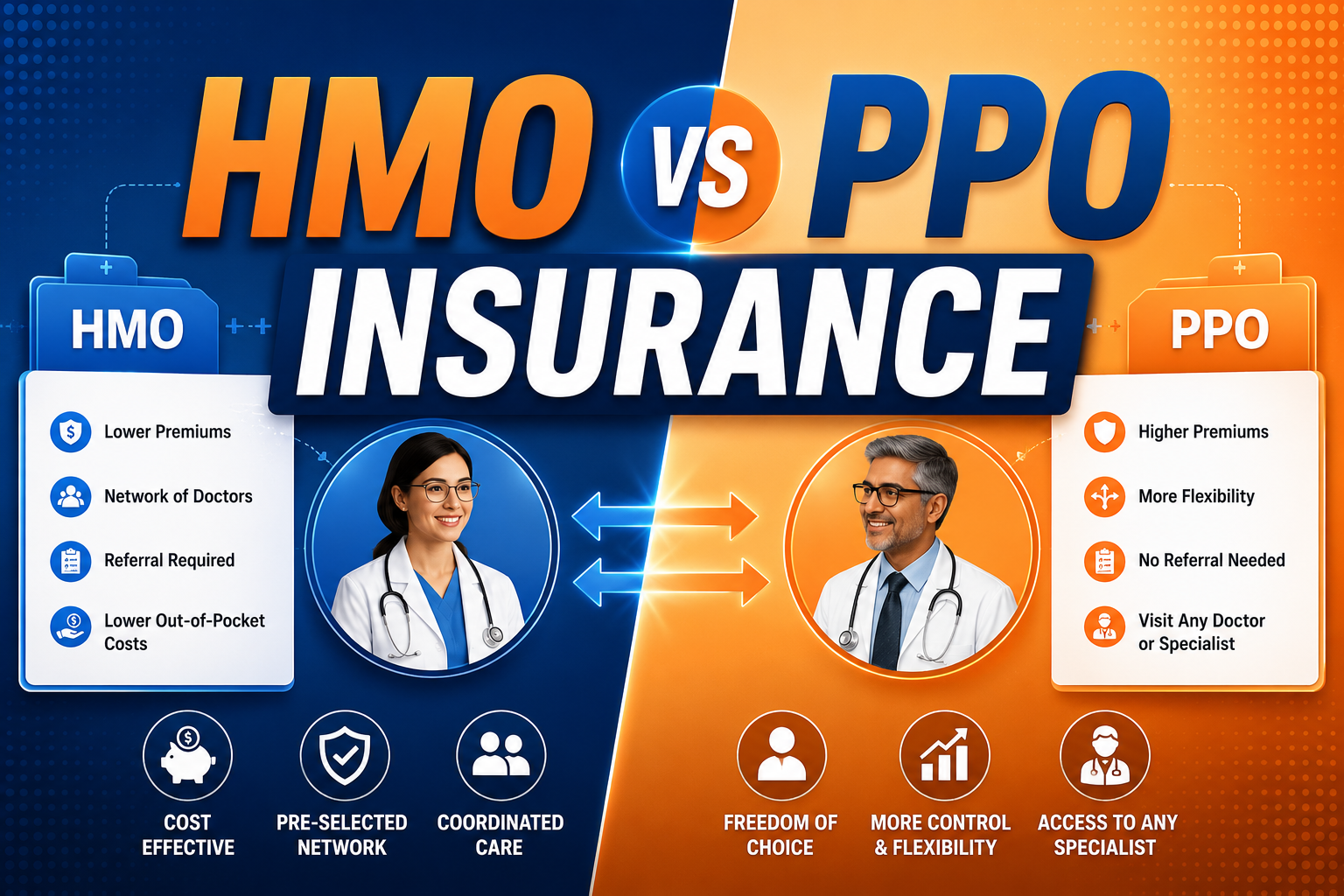
Making a health insurance decision can be quite daunting since a lot of health insurance plans seem the same. But in the case of comparing HMO vs PPO Insurance it will come into the picture as soon as you begin using health services. Not only the doctors you can see, how much you will pay every month, and whether you need to be referred, but also the degree of freedom you will have to select the specialists will depend on the type of plan you choose.
Most individuals consider monthly premium only when making comparisons of plans. In practice, the correct decision is based on your medical requirements, family circumstances, travel and the long-run care costs. Knowing these distinctions at enrollment can save you the unwanted surprising bills and even ensure that you obtain care efficiently.
HMO vs PPO Insurance: Quick Comparison Table
It is better to discuss the key differences in advance before delving into the details. This comparison brings out the factors the majority of consumers put into consideration when choosing health covering.
| Feature | HMO (Health Maintenance Organization) | PPO (Preferred Provider Organization) |
| Monthly Premium | Usually Lower | Usually Higher |
| Primary Care Physician Required | Yes | Usually No |
| Specialist Referral Needed | Yes | No |
| In-Network Coverage | Required for most services | Preferred but not mandatory |
| Out-of-Network Coverage | Rarely covered | Covered at higher cost |
| Flexibility | Limited | High |
| Deductibles | Lower | Higher |
| Claims Management | Simpler | More complex |
| Best For | Cost-conscious individuals | People wanting provider flexibility |
| Emergency Coverage | Covered | Covered |
To a majority of the consumers, this is a trade off between cost and flexibility. HMO plans are less expensive and it imposes more restrictions on the health options whereas the PPO plan is less expensive and offers more freedom.
What Is an HMO Insurance Plan and How Does It Work?
An HMO, or a Health Maintenance Organization, is a health insurance plan whose structure is based upon a known group of healthcare facilities. Members are usually obliged to be taken care of by medical doctors, hospitals and specialists on the network of the plan.
The use of a Primary Care Physician (PCP) is one of the characteristic attributes of an HMO. This doctor is the main coordinator of your healthcare needs. When you need special care provided by a specialist doctor, then your primary doctor normally gives you the referral to seek the services of a specialist doctor.
Key Characteristics of HMO Plans
- Lower monthly premiums
- Lower out-of-pocket expenses
- Doctor needed in primary care.
- Specialist referrals required
- Limited out-of-network coverage
- Coordinated healthcare management
The coordinated care model tends to avoid unnecessary testing, redundant care, and costs and broken health care experiences. Lots of patients enjoy their primary care physician in charge of managing their well being.
Example of an HMO in Practice
Suppose you have developed some chronic knee pain. With an HMO program, you would first make a visit to your primary care doctor. Once your doctor examines you, he or she might refer you to an orthopedic specialist in the network. Although it takes an additional step, it assists in getting a coordinated treatment and reduces the overall costs.
What Is a PPO Insurance Plan and Why Is It More Flexible?
The Preferred Provider Organization (PPO) offers a much greater degree of freedom in terms of the possibility to select healthcare providers. Members are able to see specialists, hospitals, and physicians without having to get referrals to a primary care doctor.
Even though PPO plans have preferred provider networks, policyholders are also able to seek care out of the provider network. Insurance company still helps in covering the expenses, though the member usually settles a bigger portion of the bill.
Key Characteristics of PPO Plans
- No referral requirements
- Greater provider choice
- Out-of-network benefits available
- Rapid access to professionals.
- Increased premiums and deductibles.
- Increased healthcare flexibility
PPO plans are adopted by many professionals, business travelers and people with chronic conditions as it eases access to specialized medical care.
Example of a PPO in Practice
Imagine that you have been having migraines so often and you wish to meet a neurologist. In a PPO plan, a visit to a primary care doctor prior to making the appointment to learn more about yourself can be scheduled accordingly. This immediate access can be time saving and offer a higher level of control of healthcare choice.
Difference Between HMO and PPO Insurance: The Factors That Matter Most
Consumers compare the ppo vs hmo insurance, and tend to worry on monthly premiums. Although cost is a consideration, provider availability, referral conditions and network versatility often play a significant role in the overall healthcare experience.
The areas that are the most important during choosing a plan are discussed below:
| Comparison Area | HMO | PPO |
| Provider Choice | Limited Network | Extensive Network |
| Specialist Access | Referral Required | Direct Access |
| Out-of-Network Care | Typically Not Covered | Partially Covered |
| Monthly Cost | Lower | Higher |
| Administrative Simplicity | Easier | More Complex |
| Care Coordination | Strong | Self-Managed |
| Flexibility During Travel | Limited | Better |
| Best for Specialist Care | Moderate | Excellent |
This underlying difference is simple. Cost savings and coordinated care are prioritized by HMO plans whereas the PPO plans emphasis is on convenience and flexibility with providers.
HMO vs PPO Health Insurance Cost Comparison: What Will You Actually Pay?
Premiums that are paid monthly are just one component of spending in healthcare. This should all be compared, including deductibles, copays, coinsurance, annual out-of-pocket maximums.
With numerous consumers opting to buy lower-premium plans without factoring in their doctor visit frequency, it implies that most of them will not benefit from the coverage. Such an error may cause increased total healthcare expenses during the year.
Typical Cost Breakdown
| Cost Type | HMO | PPO |
| Premiums | Lower | Higher |
| Deductibles | Lower | Higher |
| Copayments | Lower | Higher |
| Coinsurance | Lower | Higher |
| Out-of-Pocket Maximum | Usually Lower | Usually Higher |
Factors That Affect Your Actual Costs
- Frequency of doctor visits
- Turkey. Requirement of special attention.
- Prescription medication requirements
- Hospital admissions
- Out-of-network usage
- Chronic health conditions
A person who visits a doctor multiple times a month may be having quite different financial results to a person who has to visit a doctor once per year only to prevent possible health issues.
Which Is Better for Families: HMO or PPO?
Families always encounter special healthcare needs since various members are in need of care at any time of the year. Hospital visits of children, visits to specialists, vaccination, and even emergency visits are all adding to general healthcare expenditures.
The most preferable would be based on the family needs of medical bills and budget consideration.
HMO May Be Better For Families Who
- Desire affordable medical expenses.
- Frequently use local providers.
- Have fairly healthy relatives.
- Like to have coordinated medical care.
PPO May Be Better For Families Who
- Need multiple specialists
- Travel frequently
- Give birth to children who have made illnesses that are chronic.
- Desire greater access to providers.
Increasing families tend to prioritize access to providers and expert access over premium rates.
HMO vs PPO Insurance for Chronic Conditions and Specialist Care
The target population (individuals with chronic illnesses) tends to weigh plans with more weight compared to healthy individuals. Such illnesses like diabetes, cancer, heart disease, rheumatoid arthritis, and auto immune disorders often necessitate continuing expert care.
The access to those specialists could be simplified with the help of a PPO since there is usually no need in references.
Conditions That Often Benefit From PPO Flexibility
- Diabetes
- Heart disease
- Cancer treatment
- Neurological disorders
- Autoimmune diseases
- Chronic orthopedic conditions
Nevertheless, integrated HMO plans are occasionally able to provide great chronic disease care at a much lesser cost. The plan type is not as important as the quality of the provider network.
Which Plan Is Better for Frequent Travelers and Remote Workers?
It is more complex as people spend much time beyond their home region, rendering healthcare access more complex. Remote workers, consultants, salespeople, and other digital travelers and retirees who alternate between destinations tend to focus on provider flexibility.
Travel Considerations
| Factor | HMO | PPO |
| Coverage Outside Home Area | Limited | Broader |
| Specialist Access While Traveling | Restricted | Easier |
| Out-of-State Care | Often Limited | More Accessible |
| Network Dependence | High | Moderate |
PPO plans tend to be a more comfortable healthcare experience to people who travel extensively across the states or regions.
Common Mistakes People Make When Choosing Between HMO and PPO
Most consumers choose a plan and only later realize that there are limitations which they never expected.
The most prevalent enrolment errors are:
- Ignoring provider networks
- Forgetting specialist needs
- Overlooking deductible amounts
- Suppose that referrals are not needed.
- Not checking prescription coverage
- Not thinking about future health requirement.
- Selection on the water of monthly cost.
One must make decisions on health plans based on the expected amount of healthcare use in a year and not solely on the cost of the insurance.
How to Decide Between an HMO and PPO Based on Your Situation
The most appropriate health insurance will solely rely on your situation. No universal solution is best since the needs of healthcare differ greatly among individuals.
Select an HMO When You:
- Want lower premiums
- Prefer predictable costs
- Rarely use specialists
- Have trusted in-network providers
- Value coordinated care
Select PPO When You:
- Desires great provider flexibility.
- Frequently visit specialists
- Travel often
- Need out-of-network options
- Would rather make your own healthcare choices.
One practical method of making the decision is to determine using estimates, the number of visits to the doctor, visits to specialists, prescriptions, and medical procedures you are likely to attend in the upcoming year. Taking a comparison of total annual costs usually brings out the best alternative.
Final Verdict: Is HMO or PPO Insurance the Better Choice?
HMO vs PMO Insurance boils down to the end, and it is either affordability or flexibility. HMO plans usually offer low premium rates, reduced out of pocket and integrated healthcare services, which make them appealing to cost-conscious individuals and families. PPO plans are more inclusive in terms of access to providers, access to specialists easier and out-of-network coverage is available, making them worth consideration in the pursuit of convenience and choice.
An HMO can be the most economical choice to healthy persons whose primary health care requirements are preventive. A PPO can be worth the higher cost due to increased healthcare freedom to people who are chronically ill, have specialist needs, or whose travel patterns require frequent travels. Not the lowest cost plan or the most versatile plan is the wisest but one that most closely suits your anticipated healthcare requirements over the next year.
Also Read About :- Term vs Whole Life Insurance: Which Is Right for You?


Leave a Reply