
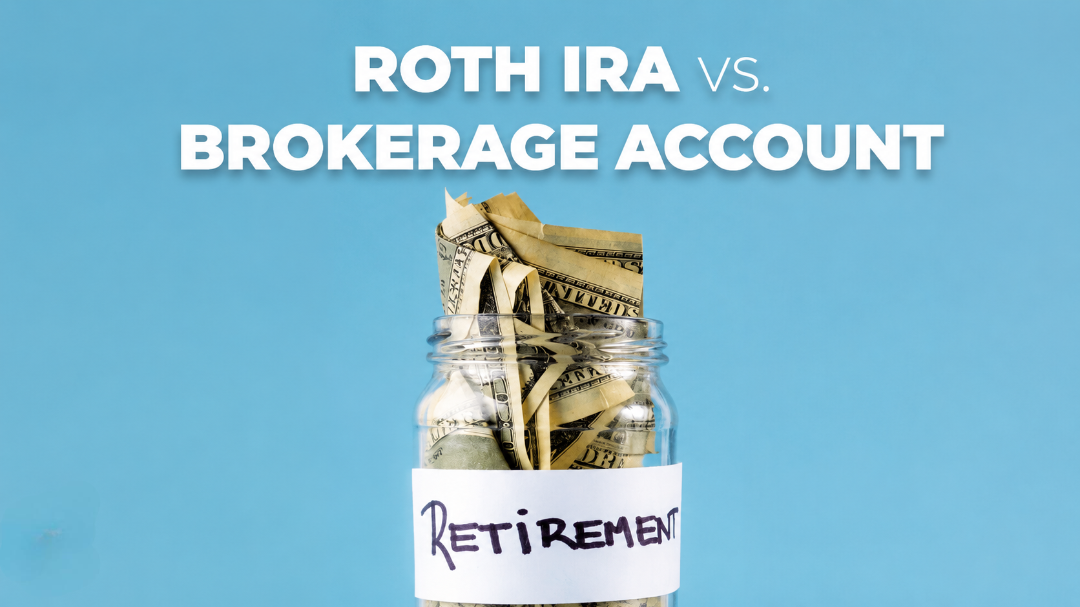
One of the initial real choices any beginner investor has to make is whether to choose a Roth IRA vs brokerage account. Both allow you to purchase stocks, ETFs and funds – but each is designed to do a different job. The idea behind a Roth IRA is to accumulate your retirement funds tax-free whereas a brokerage account is accumulated to be flexible and there is no regulation as to when and why you withdraw.
This guide simplifies the brokerage account/Roth IRA choice decision, discusses what a brokerage account is to anyone just starting out, and discusses how one opens a brokerage account step by step.
Roth IRA vs Brokerage Account: Side-by-Side Comparison
It is useful first to overview both accounts side by side before going into the details. The following table discusses differences that are most important in determining where to invest.
| Feature | Roth IRA | Brokerage Account |
| Main purpose | Retirement savings | General investing, any goal |
| Tax treatment | Tax-free growth and withdrawals | Capital gains and dividend taxes apply |
| Contribution limit (2026) | $7,000/year ($8,000 if 50+) | No limit |
| Income limits | Yes — phases out at higher incomes | None |
| Withdrawal rules | Contributions anytime; earnings restricted before 59½ | Withdraw anytime, no penalty |
| Required minimum distributions | None | None |
| Investment options | Stocks, ETFs, mutual funds, bonds | Stocks, ETFs, mutual funds, bonds, options |
| Best for | Long-term retirement growth | Short- and medium-term goals |
What Is a Brokerage Account?
A brokerage account is a normal investment account that allows you to buy and sell stocks, ETFs, bonds and funds but has no limitations when it comes to drawing money. It is the most liberal form of investment account in existence and in contrast to the Roth IRA, there are no income brackets, no contribution limitations and no age restrictions.
What does it mean by a brokerage account? in layman language: It is simply a box to hold your investments that you can replenish, expand and withdraw at any time life may force its hand, a home down payment, a business start-up, or even just more wealth-building, not retirement-related.
How to Open a Brokerage Account?
It is more quick to open than most people anticipate – normally less than 15 minutes on-line. The following are the steps which will be followed in an easy way to be familiar with the outcome before you commence.
| Step | What You Do |
| 1. Pick a broker | Compare firms like Fidelity, Schwab, or Vanguard for fees and tools |
| 2. Apply online | Provide name, address, date of birth, and SSN/Tax ID |
| 3. Link your bank | Connect a checking or savings account for funding |
| 4. Fund the account | Transfer money electronically (most are instant or 1–2 days) |
| 5. Choose investments | Many beginners start with a broad index fund or ETF |
You will be able to invest in the account once your identity is checked and your money is already cleared.
What Is a Roth IRA?
A Roth IRA is a retirement account funded with money you’ve already paid taxes on. In exchange, your investments grow completely tax-free, and qualified withdrawals in retirement owe nothing to the IRS – no matter how much the account has grown.
It’s built specifically for long-term retirement savings, which is why it comes with rules a brokerage account doesn’t: annual contribution limits, income eligibility caps, and restrictions on withdrawing earnings before age 59½. In return for those rules, you get decades of compounding with zero tax drag along the way.
Roth IRA vs Brokerage Account: Tax Differences
The two accounts differ the most in taxes, and this would be the one largest consideration in the decision between the roth ira and the brokerage account on a long term basis. They both spend after-tax funds, but beyond that, it differs radically.
| Tax Event | Roth IRA | Brokerage Account |
| Dividends received | Tax-free | Taxed annually |
| Selling at a profit | Tax-free if qualified | Capital gains tax owed |
| Retirement withdrawals | Tax-free if qualified | Taxed like any other sale |
| Annual tax forms | Minimal to none | 1099s every year |
This difference accumulates over a period of more than 20- 30 years. Eschewing taxes on annual dividends and capital gains within a Roth IRA means fewer funds are withdrawn and put into investment.
Brokerage Account vs Roth IRA: Which Fits Your Goal?
It doesn’t matter which of them sounds better on paper, but rather the right account relies on the type of objective you are funding. This is the rundown by the major life objective.
| Your Goal | Better Choice |
| Retirement in 20+ years | Roth IRA |
| Buying a house in 5–10 years | Brokerage account |
| Starting a business soon | Brokerage account |
| Maximizing long-term tax savings | Roth IRA, then brokerage |
| General wealth building | Both, used together |
The majority of financial advisors propose to fund a Roth IRA (assuming qualification) to get the tax benefit and then divert additional savings into a brokerage account after that limit is reached.
Contribution Limits and Eligibility
Roth IRAs have regulations which the brokerage accounts do not possess. Upfront information prevents an unpleasant tax reveal in the future.
| Rule | Roth IRA | Brokerage Account |
| Annual contribution cap | Yes (IRS limit, indexed yearly) | None |
| Income phase-out | Yes, above certain MAGI thresholds | None |
| Must have earned income | Yes | No |
| Age minimum | None | None |
When you earn too much money to influx into a Roth IRA, there is nothing like that in a brokerage account – anyone can go in there to invest no matter what their earnings are.
What I’d Choose, and Why?
Before I settled either at the brokerage account or the Roth IRA, I would open the Roth IRA first, but only due to the order of things, not because the brokerage account is inferior.
It works as follows: a Roth IRA tax-free compounding is an opportunity that a person can either utilize or lose depending on the calendar year. Otherwise, you have until the end of the year to contribute, and you lose the contribution room of that year, and never see it again. There is no rush in a brokerage account since it does not have any deadline. It is because of that asymmetry that the Roth takes the first place in my own order, and not because it is somehow the better description in an abstract sense.
Why I Still Keep a Brokerage Account Running
That notwithstanding, I would not commit all my investment in the Roth and leave the brokerage account. My actual test came with the fact that a mid-term objective materialized sooner than anticipated that of having to get money before I reached retirement age. The money imprisoned in a Roth fund does not (easily) get accessible taxes or penalties whereas a brokerage account does. In practice in my own split would be max the Roth first so that it can compound tax-free, followed by putting any excess in a brokerage account so I can be out of my own funds without ten years to go in case of change of plan.
When the time frame you need the cash is actually 20+ years and you do not think you will require the cash, lean Roth-heavy. In case you think you might need some of that money earlier, a place to live in, an enterprise, anything speculative, put more in the brokerage account, though that may necessitate some additional drag in the teeth of taxation. There is a price to flexibility, and a price to lack of flexibility.
Conclusion
It is not a matter of roth ira vs brokerage account of one winner and one loser, they address various issues. A Roth IRA will treat you well by waiting decades to grow tax-free whereas the brokerage account will treat you well by letting you have full and at most penalty-free access to your money any time. The great solution is in most cases not to pick between the two, but to utilise both but in the sequence of getting the money right away.
Frequently Asked Questions
Is a Roth IRA better than a brokerage account?
Yes, on the case of a retirement, the tax-free growth typically prevails. A brokerage account is more appropriate in case of flexible, short-term objectives.
Can I have both a Roth IRA and a brokerage account?
Yea, and the vast majority of experienced investors do. They are not commonly chosen as either or, but instead they are used together.
What is a brokerage account used for besides retirement?
It may finance virtually anything house, business, travel or even if you want to simply put your money anywhere any time.
How to open a brokerage account if I’m a beginner?
Select a broker, provide a few ID details online, connect with your bank, add money and select your first investment – usually less than 15 minutes.
Does a brokerage account have withdrawal penalties?
No. In contrast to the regulations of a Roth IRA in regard to early withdrawals, which include the retrieval of earnings, in a brokerage account there is no restriction on accessibility to money.
Also Read About :- ETF vs Mutual Fund: Key Differences, Costs & Which to Pick




Leave a Reply