

One of the best long-term wealth building investments is investing in mutual funds. Nevertheless, investors are likely to encounter an even greater question before choosing a fund. Should they do it in stages with a Systematic Investment Plan (SIP) or should this be in one lump sum?
The response is not limited to anticipated returns. They are income stability, market conditions, risk tolerance, and investment goals. The two strategies have generated a lot of wealth to the investors over time, yet they differ in operation and are applicable in various financial scenarios.
The debate of whether to invest in SIP vs lump sum investment has gained relevance as more individuals start to invest in the future to secure retirement, education of their children, home ownership and financial independence. Both approaches could be comprehended and allow investors to make their decisions more wisely and prevent expensive errors.
SIP vs Lump Sum Investment: Complete Comparison
The two modalities are geared towards wealth generation via mutual funds. The distinction is in the entry of money into the market and the experiences of the investors under fluctuations of the market.
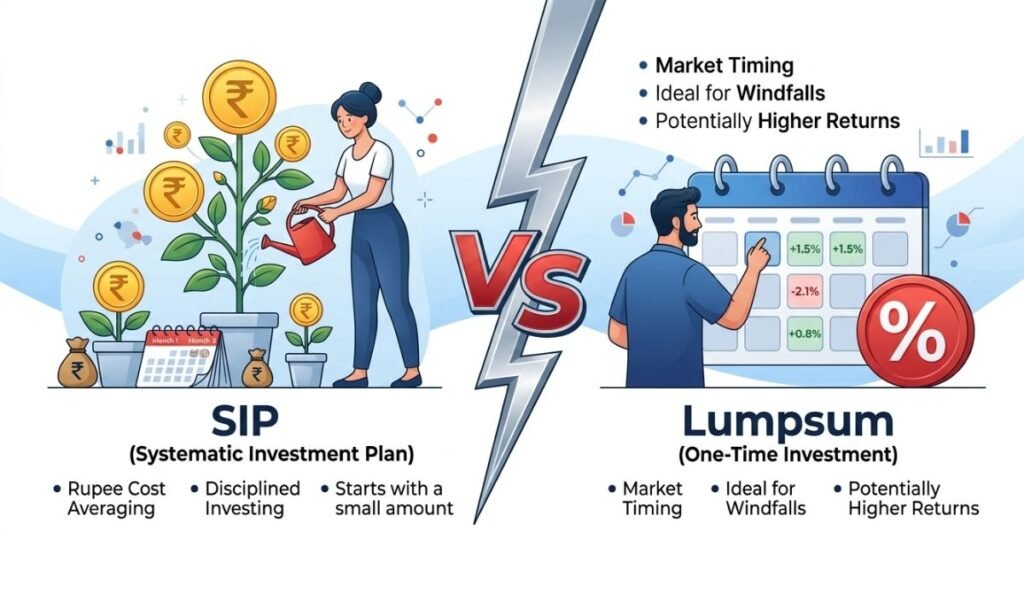
Although SIPs are aiming at uniformity and gradual amounts, lump sum investments are emphasizing on immediate involvement.
Detailed Comparison
| Aspect | SIP | Lump Sum |
| Investment Frequency | Regular | One-Time |
| Market Timing Requirement | Low | High |
| Capital Requirement | Low | High |
| Risk Exposure | Moderate | Higher |
| Emotional Pressure | Lower | Higher |
| Flexibility | High | Moderate |
| Wealth Creation Potential | High | High |
| Suitable For | Salaried Investors | Investors with Large Capital |
| Compounding Start | Gradual | Immediate |
| Volatility Impact | Reduced | Higher |
What Is SIP Investing?
A Systematic investment plan gives an investor an opportunity to invest a lump sum of money towards a mutual fund at a specific time interval. The reason why most investors have opted to do monthly contributions is that it is evident as the involuntary event in salary cycles and household budgeting.
Investors are also able to start with a small amount now without the need to wait until they get a substantial amount of money. This allows individuals across income levels the ability to invest in it.
Consistency is one of the largest SIP investing benefits. Also, investors invest also at market lows and highs thus will be allowed to get involved in market development without concerns about timing.
How SIP Creates Wealth?
- Discipline in finance comes as a result of regular investing.
- Ruppee cost averaging decreases timing risk.
- Compounding in the long run promotes growth.
- Small investments pay off in the long run.
- Emotional investing is cut down.
Core Features of SIP
| Feature | Description |
| Investment Frequency | Monthly, quarterly, or weekly |
| Starting Amount | Can begin with small contributions |
| Market Timing Dependency | Low |
| Investment Style | Gradual |
| Flexibility | High |
| Suitable For | Salaried individuals and beginners |
What Is Lump Sum Investing?
Lump sum investment is the involvement of huge sums of money collected and invested in a mutual fund at one time. The entire amount of investment is in the market within a short period of time as opposed to having a spread out investment. This is the tactic employed by investors who get bonuses, hereditary money, profits of selling property or business.
Because the whole investment begins to pay back during the first day, lump sum investing potentially brings a lot of returns in case the markets are doing well. But it also subjects the investors to increased short-term flukes.
How Lump Sum Investments Grow?
The advantage of a lump sum investment is that it becomes available in the market immediately. Any rupee invested starts compounding immediately. When market valuations are favourable during the time of investment, investors can record good wealth creation during the long-run period.
The effectiveness of this strategy usually hinges on the period of investment and time of market penetration.
Key Features of Lump Sum Investing
| Feature | Description |
| Investment Frequency | One-time |
| Capital Requirement | High |
| Market Timing Dependency | Higher |
| Compounding Start | Immediate |
| Flexibility | Moderate |
| Suitable For | Investors with surplus funds |
Important Factors to Consider Before Choosing an Investment Method
Return is not the only thing that is needed when it comes to the exercise of making an investment strategy. Investors ought to assess their respective situations and financial goals and then make a choice. What is the correct approach to a young, salaried worker might not work with a business owner or retiree. Knowing about personal needs is useful in designing a more sustainable investment plan.
Factors That Influence the Decision
| Factor | Why It Matters? |
| Financial Goals | Determines investment approach |
| Risk Tolerance | Influences comfort with volatility |
| Time Horizon | Impacts wealth creation potential |
| Income Stability | Supports regular investing |
| Available Capital | Determines investment flexibility |
| Market Conditions | Affects entry opportunities |
| Liquidity Needs | Impacts investment decisions |
| Investment Knowledge | Helps manage risk effectively |
Benefits of SIP Investing
SIPs have become the most popular and acceptable form of creating wealth in that it makes the process a lot easier. Large sums of money or market expertise are not required of investors to get started. Long-term discipline is simply a natural attribute of SIP investing.
Major Advantages
Rupee Cost Averaging
When the prices are less, investors purchase more units and when the prices are higher, they purchase less. This assists in equalizing costs of acquisitions in the long run.
Investment Discipline
Automated investments are a strong motivating factor to maintain saving patterns and to discourage building naivety to procrastinate.
Lower Emotional Stress
Investments are done on a regular basis and investors do not have to worry about entry points in a market.
SIP Benefits at a Glance
| Benefit | Impact |
| Cost Averaging | Reduces timing risk |
| Discipline | Encourages regular investing |
| Accessibility | Suitable for all budgets |
| Flexibility | Easy to start and modify |
| Long-Term Growth | Supports compounding |
Benefits of Lump Sum Investing
Lump sum investment can be very lucrative in situations where the capital at the disposal of the investor and the duration of the investment is long. Lump sum investments are common to many experienced investors when they come across favorable opportunities in the market.
Major Advantages
Immediate Market Participation
The whole capital does not begin to work gradually but the first moment.
Full Compounding Benefit
The money invested will start paying off the first day.
Simpler Portfolio Management
Investors do not have to decide repeatedly but make a single investment decision.
Lump Sum Advantages
| Benefit | Impact |
| Immediate Exposure | Faster participation |
| Full Compounding | Potentially higher growth |
| Simplicity | Easier execution |
| Efficient Capital Deployment | Uses available funds effectively |
| Long-Term Potential | Strong wealth creation opportunities |
Risk vs Reward: Which Investment Carries More Risk?
One of the most significant factors in investment remains as risk. The investment is diversified over a period of months or years through SIPs leading to reduction in risk due to a mismatch of market timing. In lump sum investments the capital is at risk on the market right away. The two methods do not fully eliminate risk but cope in different ways.
Risk Comparison
| Risk Factor | SIP | Lump Sum |
| Market Timing Risk | Lower | Higher |
| Volatility Impact | Moderate | High |
| Capital Exposure | Gradual | Immediate |
| Emotional Pressure | Lower | Higher |
| Portfolio Stability | Better During Volatility | Depends on Market Entry |
Return Potential: Which Strategy Can Generate Better Wealth?
Both the strategies have the potential to generate a lot of wealth in the long term. The result usually based on the market conditions and the duration of investment. Lump sum could perform better in a long bull market since all the capital is involved in the initial stages. SIPs can perform better in markets where there is a lot of volatility due to the advantages of cost averaging.
Long-Term Wealth Creation Illustration
| Investment Type | Potential Outcome |
| SIP | Consistent accumulation through disciplined investing |
| Lump Sum | Faster growth during favorable market conditions |
| Hybrid Approach | Balanced growth and risk management |
Why Investor Psychology Matters More Than Most People Realize?
Behavior is usually what determines the success of investments and not the investment products. A large number of investors pull out when the market falls. Some sit and wait indefinitely until they have the so-called perfect opportunity and waste years of their life.
Effective investors stick around and not anticipate each and every market movement.
Common Behavioral Mistakes
- Avoiding investing until there is a crash in the market.
- Suspension of SIPs in corrections.
- Sale fear in the wake of temporary decreases.
- Pursuing the best performing funds of the last year.
- Emotional investment decision making.
SIP vs Lump Sum Investment Planning for Different Investor Types
The financial situations of each investor are different. A combination of patterns of income and experience in investment is usually important in the process of selecting the appropriate strategy.
Which Strategy Fits You?
| Investor Type | Better Choice |
| Beginner | SIP |
| Salaried Professional | SIP |
| Business Owner | SIP + Lump Sum |
| High-Net-Worth Investor | Combination Strategy |
| Conservative Investor | SIP |
| Aggressive Investor | Lump Sum |
| Long-Term Wealth Builder | Combination Strategy |
Real-Life Investor Examples: Different Approaches, Different Outcomes
Real-life situations assist investors in picturing how the strategies will actualize.
Investor A: Monthly SIP Investor
Rahul invests ₹25,000 every month into equity mutual funds. He is concentrated on stability and does not pay much attention to short-term movements of the market. With time, he will make a slow accumulation of wealth but less timing risk.
Investor B: Lump Sum Investor
Anita earns 20 lakh selling her property and places all the money in diversified equity funds. Her investment enjoys the immediate participation by the market and long-term compounding.
Comparison
| Factor | Investor A | Investor B |
| Investment Method | SIP | Lump Sum |
| Capital Requirement | Low | High |
| Timing Risk | Lower | Higher |
| Volatility Exposure | Moderate | High |
| Flexibility | High | Moderate |
Why Diversification Remains the Foundation of Successful Investing?
Diversification cushions the investors against dependence on a single asset or market segment. Diversification by investing in a number of securities is inherent in mutual funds. A wide range of knowledgeable investors find diversification as one of the most efficient means of risk handling.
Benefits of Diversification
- Reduces portfolio volatility
- Guarantees company specific risk.
- Improves consistency
- Enhances long-term stability
- Reduces emotional investing
Common Mistakes Investors Make While Choosing Between SIP and Lump Sum
Minor errors are capable of having a substantial influence on the long-term wealth generation. Short-term market happenings are of interest to many investors, instead of long-term goals.
Most Common Mistakes
| Mistake | Possible Consequence |
| Delaying Investments | Missed compounding |
| Timing the Market | Poor entry decisions |
| Ignoring Goals | Lack of direction |
| Chasing Returns | Higher risk |
| Lack of Diversification | Increased volatility |
Can SIP and Lump Sum Be Used Together?
Yes, It is advised by many financial experts to use a combination of the two methods. Investors will be able to invest using available capital in real time and make monthly SIP investments at the same time.
Hybrid Investment Strategy Example
| Investment Method | Allocation |
| Lump Sum | ₹10 Lakh |
| Monthly SIP | ₹25,000 |
| Review Frequency | Annual |
| Goal | Long-Term Wealth Creation |
This method offers short-term market exposure and continuous buildup.
Expert Observation: What Successful Long-Term Investors Usually Do?
Having considered the behavior of investors in various market cycles, it comes out to be a constant pattern. The best investors are very few and far between who forecast every market action right. They typically:
- Invest consistently.
- Be disciplined in turbulence.
- Concentrate on the long run.
- Avoid emotional decisions.
- Review portfolios periodically.
Perfect timing and patience can make wealth.
Why Many Investors Make the Wrong Choice Between SIP and Lump Sum Investing?
Most individuals are concerned with returns when it comes to comparing investment choices. They waste many hours trying to find the right moment to invest and they can take long before making a decision anticipating that the market will swing their way. Actually, proper timing in investment is seldom successful. It mostly concerns consistency, perseverance and adherence to a long-term program.
The greatest errors are usually made when investors allow their feelings to affect their judgments. Fear in down markets and excitement in boom markets may result in poor decision making that depletes the wealth in the long run.
Common Misunderstandings That Can Impact Investment Results
| Misconception | What Actually Matters |
| Waiting for the market to crash before investing | Time in the market is often more important than timing the market |
| Stopping SIPs when markets fall | Market corrections can help accumulate more units at lower prices |
| Investing all available money without keeping emergency funds | Financial security should always come before investing |
| Judging investments based on a few months of returns | Wealth creation is usually measured over years, not months |
| Believing one strategy works for everyone | The best approach depends on goals, income, and risk tolerance |
The Real Lesson Successful Investors Learn
Seasoned investors know that nobody can always have an idea when the market will be high and when it will be at its lowest level. They are also not concerned with an attempt to predict all the movements of the market, rather, they are committed to a routine of disciplined investment. It is the same thing whether they invest in SIPs, lump sum investment or both: they should stay invested, have patience and they should allow their investment to compound over time.
In most instances the difference between a successful and unsuccessful investors is not the choice they make. What makes them capable of doing that is the strategy that they have managed to maintain both in good and poor market.
Which Investment Strategy Fits Your Situation?
Choosing between SIP and lump sum investing depends on your financial circumstances, available capital, and investment goals. The table below provides a simple guideline for different investor profiles.
| Your Situation | Recommended Option |
| Regular Monthly Salary | SIP |
| Annual Bonus or Incentive | Lump Sum |
| Long-Term Retirement Planning | SIP |
| Property Sale or Inheritance Funds | Lump Sum |
| First-Time Investor | SIP |
| Experienced Investor | Lump Sum |
| Large Idle Cash Available | Lump Sum |
| Volatile or Uncertain Markets | SIP |
Quick Insight: If you earn regularly, SIPs can help you invest consistently. If you have a substantial one-time amount available, a lump sum investment may offer immediate market exposure. Many investors also combine both strategies for a balanced approach.
What I Have Observed About Successful Investors?
After reviewing different investing approaches across various market conditions, one pattern appears consistently. Investors who remain invested for long periods usually achieve better outcomes than those who constantly try to predict market highs and lows. Whether they choose SIPs, lump sum investing, or a combination of both, discipline and patience often contribute more to wealth creation than market timing.
Final Verdict on SIP vs Lump Sum Investment
There is no overall winner on the question of SIP vs lump sum investment. They can both create a lot of wealth provided they are done in a correct manner. The SIPs offer discipline, flexibility and reduce timing risk. Lump sum investments bring with them instant market entry and possibly superior growth in propitious times.
To most investors it is possible to have a mix of the two approaches to give optimum balance between risk management and wealth creation. The trick is not to find the right strategy but to be invested, disciplined and such that through time, compounding will take its time process its own way.
Frequently Asked Questions
Is SIP better than lump sum investment?
SIPs are typically more suitable to low-income investors as well as those who have a low risk threshold.
Can I invest in both SIP and lump sum?
Yes. It is very common to find many investors combining the two strategies in order to create a balance between growth and risk.
Which strategy is safer?
Typically, SIPs are regarded as less risky since timing the market is diminished.
Which works better during market corrections?
SIPs tend to work well within fluctuating times due to the rupee cost averaging.
What do financial advisors usually recommend?
Most consultants suggest a mixture between SIP and lump sum investing depending upon the individual objectives and financial sources.
Also Read About :- Mutual Funds vs Stocks: Which Investment





Leave a Reply